
Want to Change a Pickleball Rule? You Have Until June 15.
Every pickleball player has a rule they’d “fix.” Maybe it’s the serve. Maybe it’s how spin gets called, or whether the receiving team should be able to win the game on a point they didn’t serve. You’ve heard the speech at the kitchen line a hundred times — usually somewhere between game two and the post-match beer.
Here’s the part almost nobody says out loud: you can actually do something about it. Not by yelling. By typing.
Right now, USA Pickleball is in the middle of building its 2027 rulebook, and the process is open to the public. Anyone — member or not — can read every proposed change and comment on it. That comment window closes June 15, 2026. After that, the decisions move behind committee doors. So if there’s a rule you love, hate, or think is worded like a tax form, this is your week.
Pickleball’s rulebook is a public process — really
Most players assume the rules arrive by decree, handed down each January by some shadowy council of referees. The reality is more democratic, and a lot more interesting.
USA Pickleball revises its rulebook on an annual cycle, and for 2027 it explicitly rebuilt the process around “additional transparency and opportunities for member input and comments” (USA Pickleball). Translation: they want to hear from you before the rules get set, not after.
There are two different doors here, and it’s worth knowing which one is open:
- Submitting a brand-new proposal is reserved for USA Pickleball members at the Challenger or Champion level, and that window already ran its course — it opened April 1 and closed June 1, 2026 (USA Pickleball, Membership tiers).
- Commenting on the proposals that were submitted is open to anyone, and it stays open until June 15 (USA Pickleball).
So the lever in your hands this week isn’t writing a rule from scratch — it’s shaping which of the submitted rules actually survives. That’s not a consolation prize. Public comment is exactly the signal the Rules Committee weighs when it decides what to keep, amend, or kill.
How a rule actually becomes a rule
The whole journey is seven steps, and it’s surprisingly readable once someone lays it out without the legalese. Here’s the path every proposed rule walks, start to finish.
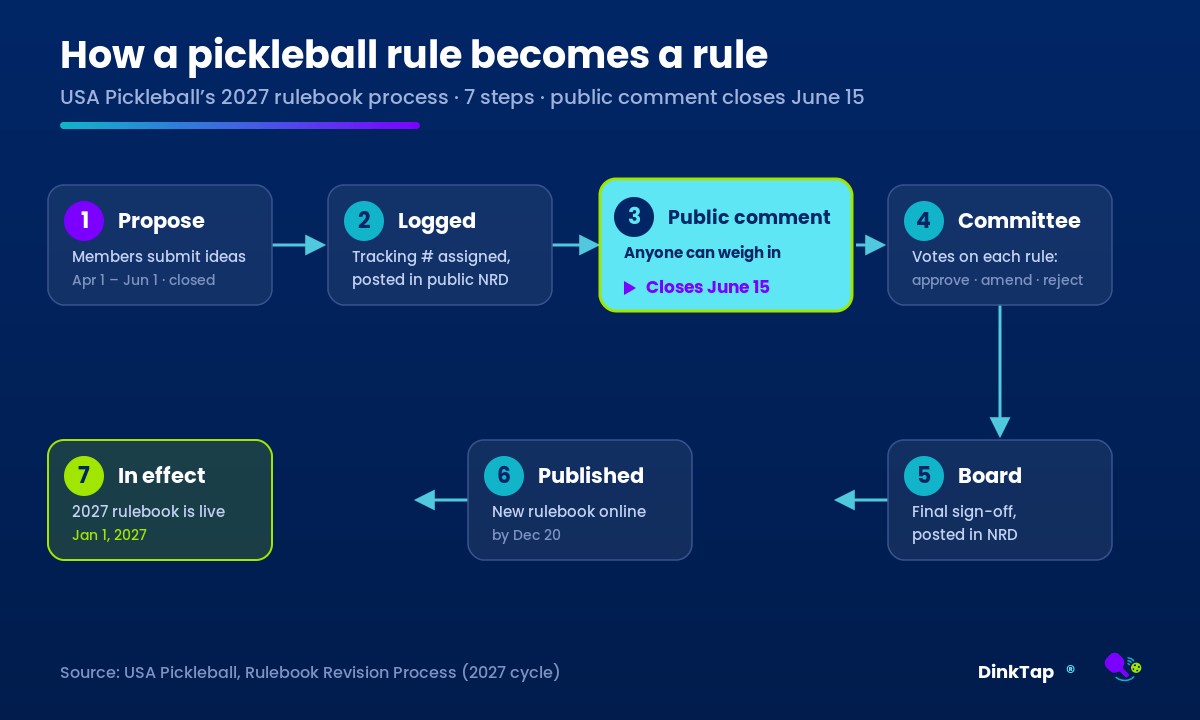
Source: USA Pickleball’s published Rulebook Revision Process. The public-comment stage (step 3) is the one open to everyone, and it closes June 15, 2026.
A few things make this better than your average suggestion box. Every proposal gets a tracking number that follows it the entire way, so you can watch a specific idea move through the system. All of it lives in the public New Rulebook Database (NRD) — submissions, comments, the committee’s votes, and the reasons behind them, right up through the Board of Directors’ final call (USA Pickleball NRD). When the committee approves, amends, or rejects something, it has to show its work. The finished 2027 rulebook gets published by December 20, then takes effect January 1, 2027 (USA Pickleball).
That’s a governing body doing its homework in a glass box. For a sport this young, it’s a genuinely healthy sign.
Wait — do rule changes even matter? Recently, a lot.
If you think the rulebook is basically frozen, look at what changed for 2026. These weren’t cosmetic tweaks; they changed how points end and how serves get judged:
- Spin serves got a clear verdict. You can impart spin at the moment your paddle contacts the ball on a serve — but you can’t pre-spin the ball with your fingers before contact. After years of “wait, is that legal?”, the 2026 book finally drew the line (The Kitchen, USA Pickleball Rulebook Change Document).
- Rally scoring stopped punishing the leader. Under the new rule, either the serving or receiving team can score the game-winning point. Playing to 15, up 14–10, and your opponent dumps their serve into the net? Game over — you win, even though you weren’t serving. Under the old logic, you’d have had to wait for your own serve to close it out (The Kitchen, Selkirk).
Whatever you think of those calls, they’re proof the rulebook is a living document — and proof that the comments and proposals feeding into it are worth taking seriously. The rule that annoyed you last season is exactly the kind of thing that gets rewritten.
How to actually have your say before June 15
You don’t need a rules certification or a law degree. You need about three minutes.
- Open the New Rulebook Database at rules.usapickleball.org. Everything proposed for 2027 is in there.
- Find a proposal you care about — browse by topic or pull up a specific tracking number if you’ve seen one floating around your league’s group chat.
- Read the actual proposed wording, not the hot-take version of it. Rules live and die on a single phrase.
- Leave a comment before June 15. Comments are open to anyone, and the window closes that day (USA Pickleball).
One tip from people who do this seriously: be specific. “I hate this” is noise. “This wording could be read two ways at the kitchen line because it doesn’t define X — here’s a cleaner sentence” is signal. The committee is sorting hundreds of inputs; the precise, on-court reasoning is what cuts through.
And if your big idea is to write a new rule rather than comment on an existing one, you’ve got time to plan for next cycle: become a Challenger- or Champion-level member, and be ready when the submission window opens next April (USA Pickleball).
Our take: this is the opposite of bureaucracy
(This part is DinkTap’s opinion, clearly labeled.) It’s easy to roll your eyes at “public comment period” — it sounds like a city council meeting about a parking ordinance. It isn’t. It’s a young sport writing its operating system out in the open, and asking regular players to help. That almost never happens in sports that have been around a century. The comment window is the single most underused power players have, and most of us let it expire every year while complaining about the very rules we declined to weigh in on. Three minutes in the database genuinely beats three months of griping between games.
There’s a reason a player-discovery company cares about any of this. Good rules are what make a game legible — everyone steps on court agreeing on how a point ends, what’s a legal serve, who won. That shared understanding is the quiet foundation under every fair, fun match, which is the whole thing DinkTap® is built to help you find more of. (Our Dynamic Mesh Rating™ (DMR) and DinkType™ chemistry read can match you to the right partners all day; they can’t tell you whether that spin serve was legal — the rulebook does that.) We’d rather that rulebook be shaped by the people actually playing than by anyone else.
So go find the rule that bugs you most, and say something useful about it — before the window shuts on June 15.
Get DinkTap →
Sources & further reading
- USA Pickleball — Rule Book Revision Process (primary): the seven-step process, the April 1–June 1 submission window, the June 15 public-comment deadline, and the January 1, 2027 effective date.
- USA Pickleball — New Rulebook Database (NRD) (primary): where every proposal, public comment, committee vote, and rationale is posted and trackable.
- USA Pickleball — Membership (primary): the Challenger and Champion levels required to submit a proposal.
- USA Pickleball — 2026 Rulebook Change Document (primary): the official record of this year’s changes, including the serve-spin and rally-scoring updates referenced above.
- The Kitchen — New USA Pickleball rule changes: What to know for 2026 (secondary): plain-English summary of the 2026 changes.
- Selkirk Sport — 2026 USA Pickleball rulebook changes (secondary): additional detail on rally scoring and serve clarifications.
A note on accuracy: dates and process steps above are quoted from USA Pickleball’s published revision process as of June 8, 2026; the public-comment deadline is June 15, 2026, and the resulting rulebook takes effect January 1, 2027. The 2026 rule examples are included to show the rulebook actively changes and are sourced to USA Pickleball’s official change document and reputable summaries. DMR and DinkType™ are DinkTap’s own frameworks, offered as player-matching tools, not as officiating or rules authorities.